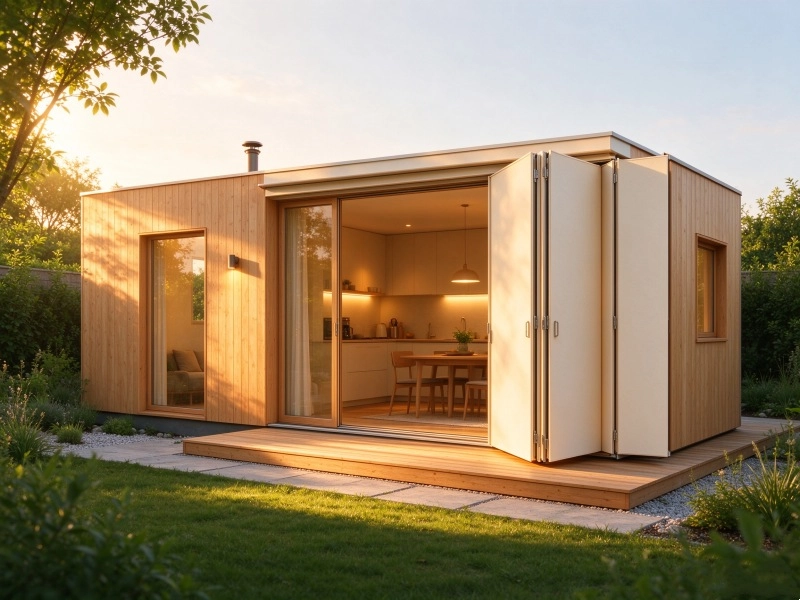
A foldable house is a type of prefabricated building that uses a folding structure and premanufactured components. During transportation, certain structural sections are folded into a compact configuration to reduce the space required for shipping. Once delivered to the site, these sections are unfolded, connected, and secured to restore the building to its intended configuration.
This design can simplify transportation and some on-site assembly tasks. However, installation still involves site preparation, structural fastening, and necessary finishing work. Understanding how a foldable house works helps buyers evaluate its suitability, installation requirements, and performance.
Many foldable houses use a steel frame as the primary supporting structure. Hinges, connectors, and locking mechanisms allow designated components to fold and unfold. Depending on the design, these components may include wall panels, roof sections, or expandable side panels.
Once unfolded, all components must be properly aligned and secured according to the design specifications. The folding mechanism enables the structural transformation, while the main frame, connection points, and locking devices must meet the applicable load-bearing and stability requirements.
Foldable houses are generally manufactured in advance, with major structural components produced in a factory. Depending on the model, wall panels, doors, windows, insulation, and other components may also be integrated before delivery. The level of prefabrication determines how much work remains on site, and delivery configurations vary between models.
Before purchasing, confirm the scope of supply, particularly whether electrical wiring, plumbing, interior finishes, and other fittings are included or require on-site installation.
The process from transportation to occupancy generally involves the following stages.
| Stage | Main Tasks | Key Checks |
|---|---|---|
| Site preparation | Prepare the site and construct the required foundation or support system | Ground-bearing capacity, levelness, and drainage |
| Transportation and positioning | Deliver the folded unit and position it at the designated location | Shipping dimensions, lifting requirements, and working space |
| Unfolding and securing | Unfold the structure, align the components, and secure the connections | Alignment, connection integrity, and locking mechanisms |
| Sealing and utility installation | Seal joints and complete necessary utility connections and finishing work | Weatherproofing, utility connections, and equipment operation |
| Final inspection | Inspect the structure, building envelope, and installed systems | Stability, safety, and applicable inspection requirements |
Unfolding the structure does not automatically make the building ready for use. Poorly sealed wall joints, roof connections, or window and door perimeters may lead to water infiltration, air leakage, or reduced insulation performance. Improperly secured connections can also compromise structural stability.
The installation team should inspect connection points, seals, and utility systems according to the manufacturer's instructions for the specific model. Lifting operations and electrical work should be performed by qualified personnel in accordance with applicable safety requirements.
A foldable house should be selected according to its intended use and the environmental conditions at the installation site. Wind loads, snow loads, rainfall, temperature changes, and foundation conditions can all affect structural performance and the building envelope.
Before purchasing, verify the design loads, anchoring methods, insulation specifications, and weatherproofing measures. For long-term residential use or projects in areas with severe weather, confirm that the product and installation plan comply with applicable local building codes.
The folding design can reduce the space occupied during transportation, but actual shipping efficiency also depends on the unit's dimensions, weight, loading configuration, and transportation restrictions.
The site must provide sufficient access for delivery and enough space to unfold the structure. If lifting equipment is required, assess its operating range, ground conditions, and lifting requirements in advance, and include the associated costs in the project budget.
Foldable houses used for construction camps, temporary offices, or residential purposes may require different levels of insulation, ventilation, sound control, sanitary facilities, and electrical provisions.
When selecting a model, verify its configuration against the intended application. Confirm requirements for utility connections, fire safety, building permits, and occupancy. A model suitable for temporary use may not meet all the requirements for long-term residential use.
Before purchasing, review the following factors:
Verifying these details in advance helps establish a more accurate project budget and prevents transportation, foundation, installation, and utility connection costs from being overlooked.