
The steel frame house has evolved from an industrial construction technique into one of the most sought-after solutions in modern residential and commercial architecture. Combining precision engineering, design freedom, and a greatly reduced environmental footprint, steel-framed structures are reshaping how developers, contractors, and homeowners approach the built environment.
This guide explores the full spectrum of steel frame house technology — from raw material specifications and structural engineering principles to thermal performance, construction workflow, and sustainability compliance — drawing on product documentation published by FSILON Home Building Materials Limited Co., Ltd, a China-based manufacturer with 19 years of research in prefabricated building solutions.
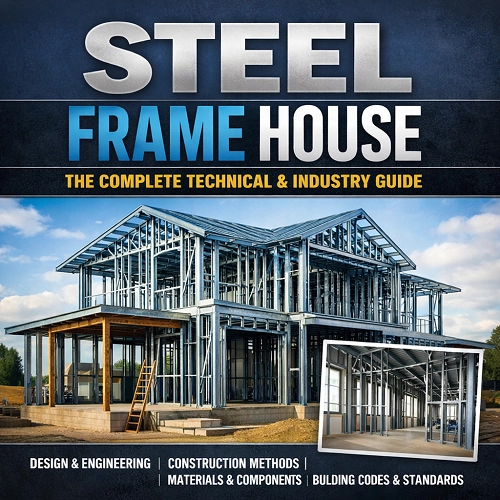
A steel frame house is a building whose primary load-bearing structure consists of cold-formed or hot-rolled steel members — typically C-section and U-section galvanized profiles — rather than timber, concrete block, or brick. The structural skeleton transfers vertical and lateral loads through a network of studs, tracks, joists, and bracing elements that are bolted or screwed together on-site or pre-assembled into panels in a factory environment.
Unlike traditional masonry, the steel frame is non-combustible, dimensionally stable, and immune to biological degradation such as rot, mould, and termite attack. FSILON's Light Steel House range exemplifies this technology at its most refined: factory-precision components shipped flat-pack and erected on-site in a fraction of the time required by conventional methods.
The following table summarises the core structural and thermal parameters of FSILON's Steel Frame House system as documented on the product specification page.
| Parameter | Specification | Standard / Note |
|---|---|---|
| Steel grade | G550 galvanized cold-formed steel | AS/NZS 1397 / GB/T 2518 |
| Frame profile thickness | 0.75 mm – 2.0 mm | Varies by load-bearing requirement |
| Stud spacing | 400 mm / 600 mm o.c. | Design-dependent |
| Wall panel thickness | 75 mm – 150 mm | Insulated sandwich panel |
| Insulation core options | Rock wool · EPS · PU foam | Fire class A / B1 |
| Maximum wind resistance | 50 m/s (180 km/h) | Equivalent to Category 3 cyclone |
| Roof snow load | ≥ 2.0 kN/m² | EN 1991-1-3 / ASCE 7 |
| Seismic performance | Zone VI (Chinese standard) | GB 50011 |
| Design service life | ≥ 50 years (with maintenance) | Corrosion-protection coating |
| Construction time reduction | Up to 50% vs. traditional build | Prefabricated modules |
A light-gauge steel frame house is engineered as a load-path system. Gravity loads (dead load, live load, snow) travel from roof purlins → roof trusses → wall studs → floor joists → foundation. Lateral loads (wind, seismic) are resisted by diagonal bracing straps or structural sheathing panels fixed to the stud frame. The connection between these elements is achieved through self-drilling screws and proprietary clips designed to resist both tension and shear.
Steel frame houses are compatible with a variety of foundation systems. The lightweight nature of the structure — typically 30–40% lighter than an equivalent masonry build — reduces foundation loads and can enable cost savings on sub-structure works.
| Foundation Type | Best For | Relative Cost |
|---|---|---|
| Reinforced concrete slab-on-grade | Flat, stable ground; permanent buildings | Medium |
| Strip / pad footing | Moderate loads, good bearing soil | Low–Medium |
| Screw pile system | Sloped terrain, weak soils, fast install | Low |
| Elevated steel subframe | Flood zones, uneven ground, eco-lodges | Medium–High |
One of the most important design decisions in a steel frame house is managing the thermal bridge created by highly conductive steel members. FSILON addresses this through an integrated insulated panel system where the insulation layer sits between the structural steel and the interior/exterior cladding, breaking the thermal path.
Non-combustible mineral fibre. Fire class A1. Excellent acoustic attenuation (Rw 45–55 dB). Preferred for commercial and multi-storey.
Expanded polystyrene. Low cost, good compressive strength, U-value 0.22–0.35 W/m²K. Ideal for moderate climate zones.
Rigid polyurethane. Highest insulation per mm (λ ≈ 0.022 W/mK). Best for cold climates and energy-efficient builds.
Continuous rigid insulation layer and thermal break clips interrupt steel stud bridging, improving effective R-value by up to 40%.
Interior wall panels are complemented by FSILON's broader prefabricated interior product ecosystem, including decorative wall panels, suspended ceilings, and SPC flooring — all factory-finished for rapid on-site integration.
The steel frame house construction process follows a disciplined sequence that dramatically compresses project timelines compared to conventional methods. Prefabrication shifts the majority of labour-intensive work to a controlled factory environment, reducing on-site activity to assembly and finishing.
| Phase | Activity | Typical Duration |
|---|---|---|
| 1. Design & Engineering | Architectural drawings, structural calculations, fabrication files | 2–4 weeks |
| 2. Factory Fabrication | CNC roll-forming, panel assembly, QC inspection, packaging | 3–6 weeks |
| 3. Site Preparation | Foundation, services rough-in, drainage | 1–3 weeks (parallel) |
| 4. Frame Erection | Floor joists, wall panels, roof trusses, bracing | 1–2 weeks |
| 5. Envelope Completion | Roofing, external cladding, windows, doors | 1–2 weeks |
| 6. Interior Fit-Out | MEP services, insulation, partitions, finishes | 2–4 weeks |
| Total (typical house) | – | 8–14 weeks |
FSILON supplies comprehensive shop drawings and erection manuals with every order, ensuring that construction teams — including those with limited prior experience in light-gauge steel — can assemble structures accurately. On-site technical support and training programmes are also available.
The construction industry accounts for roughly 38% of global CO₂ emissions (IEA, 2023). Steel frame construction addresses this challenge through multiple mechanisms: precise factory cutting eliminates the material waste typical of on-site timber framing; steel is one of the world's most recycled materials, with a global recycling rate exceeding 85%; and the lightweight structure reduces concrete use in foundations.
FSILON's commitment to sustainability is formalised through its ESG programme, which covers certified testing standards, ongoing product innovation, and alignment with internationally recognised sustainability standards.
| Sustainability Metric | Steel Frame House | Conventional Masonry |
|---|---|---|
| Material waste on-site | ~2% | ~10–15% |
| Structural weight (typical) | 30–40% lighter | Baseline |
| End-of-life recyclability | >85% | 20–40% |
| Construction water use | Minimal (dry process) | High (wet trades) |
| Embodied carbon (approximate) | Lower (less concrete) | Higher |
| Re-locatability / disassembly | Yes | No |
Steel frame house systems serve a wide range of sectors. The table below maps the primary markets to relevant product types available from FSILON's portfolio.
| Market Segment | Application | Recommended Product |
|---|---|---|
| Residential Development | Villas, townhouses, housing estates | Light Steel House |
| Eco-Tourism & Hospitality | Glamping cabins, resort chalets, boutique lodges | Space Capsule / Apple Cabin |
| Temporary & Emergency | Disaster relief shelters, worker camps | Container / Expansion House |
| Education & Healthcare | Classrooms, clinics, laboratories | Steel Frame House (custom) |
| Commercial & Office | Low-rise office buildings, showrooms | Steel Frame House (custom) |
| Interior Renovation | Fit-out, refurbishment, interior partitioning | Prefabricated Interior Range |
Choosing a structural system is one of the most consequential decisions in any construction project. The comparison below provides an objective overview of key performance attributes across the three dominant low-rise construction methods.
| Attribute | Steel Frame | Timber Frame | Masonry / Concrete |
|---|---|---|---|
| Fire resistance | Non-combustible | Combustible | Non-combustible |
| Pest / rot resistance | Excellent | Requires treatment | Good |
| Speed of construction | Fast | Moderate–fast | Slow |
| Design flexibility | High (open spans) | Moderate | Lower |
| Dimensional accuracy | ±1 mm (CNC) | ±3–5 mm | ±5–10 mm |
| Long-term maintenance | Low | High | Low–Medium |
| Recyclability (end of life) | High | Medium | Low |
FSILON Home Building Materials Limited Co., Ltd is headquartered at No. 5888 Wuyuan Road, Haiyan County, Jiaxing, Zhejiang, China — a region recognised as a global hub for prefabricated building materials manufacturing. Since the company's founding, it has remained exclusively focused on the research, development, and manufacture of prefabricated building systems and interior components.
FSILON's product portfolio spans the complete building envelope: from structural light steel houses and container homes to interior systems including doors, suspended ceilings, cabinetry, and SPC flooring. The company operates a dedicated export base and ships internationally, with its product pages available in over 30 languages.
Completed projects spanning engineering, residential, home decoration, and commercial decoration categories can be reviewed in the Projects Gallery. For technical downloads, test reports, and patents, visit the PDF Download section of the FSILON media centre.
FSILON's engineering team responds within 24 hours. Provide your floor area, intended use, and location for a tailored specification and price indication.
Get a Free Quote →